Blog

  • ‘It Felt Like Chaos’: Maika Monroe Back in Horror with Resident Evil Requiem

    Resident Evil Requiem Trailer: Maika Monroe Brings Heart and Horror to Raccoon City

    If you’re in New York City or Los Angeles, you might notice cryptic marketing popping up, including in Times Square and Hollywood: a red poster (static and motion) featuring photographs of missing people with the tagline “Evil Has Always Had a Name.”

    A QR code links to the new Resident Evil Requiem live-action trailer, starring Maika Monroe. The actress, known for Longlegs, Reminders of Him, and It Follows, describes her role as a “short-film type of dynamic.”

    “We had a lot of extras in zombie makeup just cruising around, which was quite funny,” Monroe told Entertainment Weekly. “Cops and dogs and smoke machines — it was chaos. It really felt like chaos.”

    Resident Evil Requiem poster with Maika Monroe

    Resident Evil Requiem trailer scene featuring Maika Monroe

    Maika Monroe’s Role in Resident Evil Requiem

    Monroe does not play any known Resident Evil character, including anyone from Requiem (out Feb. 27 on consoles). Instead, she tells a standalone story set in Raccoon City, featuring the Umbrella Corporation and the T-virus outbreak. She portrays a mother trying to survive the initial zombie outbreak in the 1990s.

    “First the sirens, then the emergency broadcasts… then the screams,” Monroe says. The trailer, shot in Mexico City, shows her navigating chaotic streets, dodging zombies and Lickers. A flash-forward reveals her zombified, clutching a photograph of herself and her child.

    Maika Monroe as zombified character in Resident Evil Requiem

    Behind the Scenes: Trailer Production

    Directed by Rich Lee (known for music videos with Billie Eilish, Lana Del Rey, and Eminem), the trailer features a nostalgic return to 1990s Raccoon City. Monroe, who hasn’t played the Resident Evil games, was introduced to the universe through the Milla Jovovich films.

    Monroe says, “It felt very nostalgic… the big point was going back to the ’90s, the original location of Raccoon City… and then getting to be a zombie myself, which was really exciting.”

    Resident Evil Requiem Storyline

    The story follows FBI intelligence analyst Grace Ashcroft and fan-favorite agent Leon S. Kennedy. Grace investigates an abandoned Midwestern hotel where her mother was murdered eight years prior. When a cop goes missing, Leon is dispatched to assist.

    Resident Evil Requiem trailer scene showing zombies

    Maika Monroe’s Horror Career

    Monroe, recently seen in a reimagining of The Hand That Rocks the Cradle, has a strong background in horror films. Her notable 2024 film with Nicolas Cage and director Osgood Perkins helped establish her genre credentials. She is selective with horror roles, favoring unique and compelling stories.

    She teases a return for They Follow, the sequel to her 2014 indie horror hit It Follows. “Rumors have been spreading that it will be happening… stay positive,” Monroe shares.

    Regarding the Resident Evil Requiem script, Monroe adds: “It’s not at all what I expected… staying true to the original, bringing back the same team… but the story is grander. I’m really, really excited.”

    You may query:

    • Resident Evil Requiem
    • Maika Monroe
    • Raccoon City
    • Umbrella Corporation
    • T-virus outbreak
    • Times Square marketing
    • Hollywood marketing
    • Red poster campaign
    • Live-action trailer
    • Rich Lee director
    • Leon S. Kennedy
    • Grace Ashcroft
    • Zombie prosthetics
    • Mexico City shoot
    • Longlegs
    • Reminders of Him
    • It Follows
    • Horror films
    • They Follow sequel
    • Milla Jovovich Resident Evil films

  • S&T Bancorp Q4 Earnings: How STBA Fared Against Regional Banks

    Q4 Regional Bank Earnings: Key Highlights and Takeaways

    Wrapping up Q4 earnings, we review the performance of regional banks stocks, including S&T Bancorp (NASDAQ: STBA) and its peers.

    Regional Banks: Opportunities and Challenges

    Regional banks are financial institutions that operate within specific geographic areas, connecting local depositors and borrowers. They benefit from rising interest rates that improve net interest margins, digital transformation reducing operational expenses, and strong local economies driving loan demand. Challenges include fintech competition, deposit outflows, rising credit deterioration and loan defaults during economic slowdowns, regulatory compliance costs, and stability concerns following high-profile failures or commercial real estate exposure.

    Q4 Performance Overview

    Among the 95 regional banks stocks tracked, Q4 results were generally positive. On average, revenues beat analysts’ consensus by 1.4%, and share prices increased 2.5% since earnings were announced.

    S&T Bancorp (NASDAQ: STBA)

    Founded in 1902 in western Pennsylvania, S&T Bancorp offers retail and commercial banking, cash management, trust services, and investment advisory solutions.

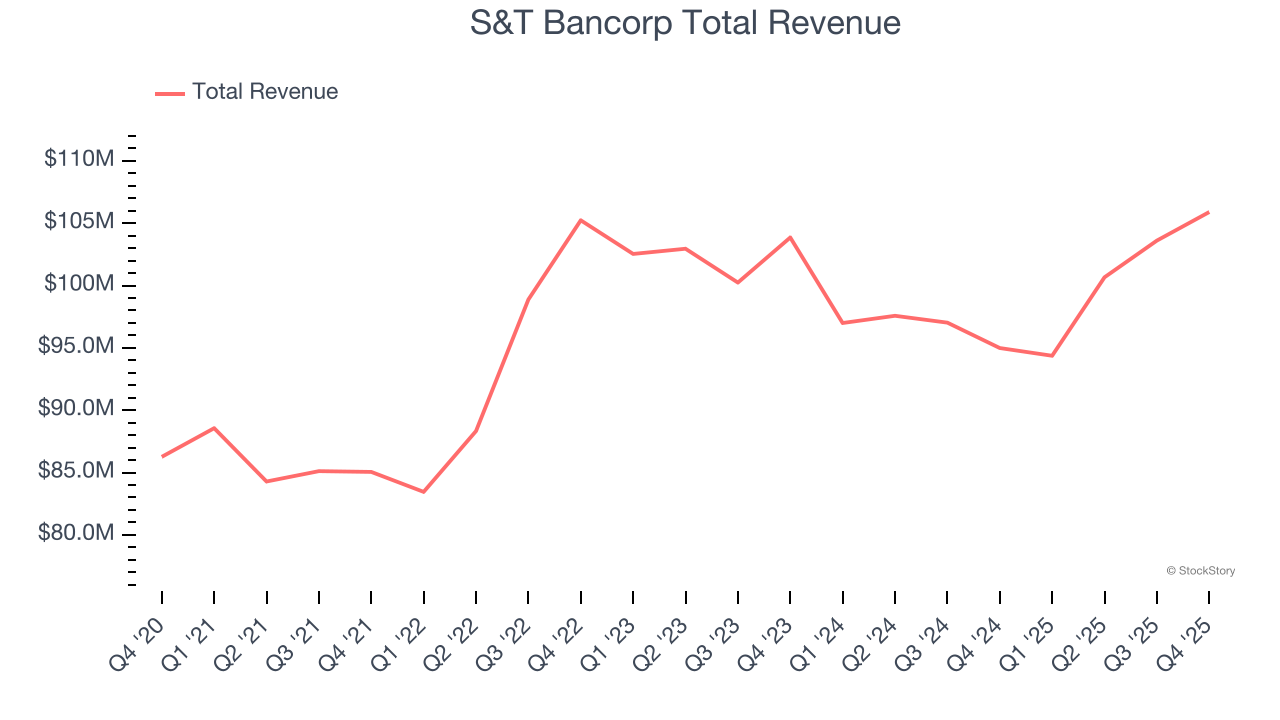
    Q4 revenue was $105.9 million, up 11.5% year-over-year, exceeding analyst expectations by 2%. EPS delivered a narrow beat, marking a mixed quarter. CEO Chris McComish stated: I’m extremely proud of the strong performance we delivered in Q4 and across 2025. These results reflect disciplined execution, continued momentum on key business drivers, and strong core profitability.

    S&T Bancorp Total Revenue Q4

    The stock is up 3.1% since reporting and currently trades at $43.23.

    Top Performer: Merchants Bancorp (NASDAQ: MBIN)

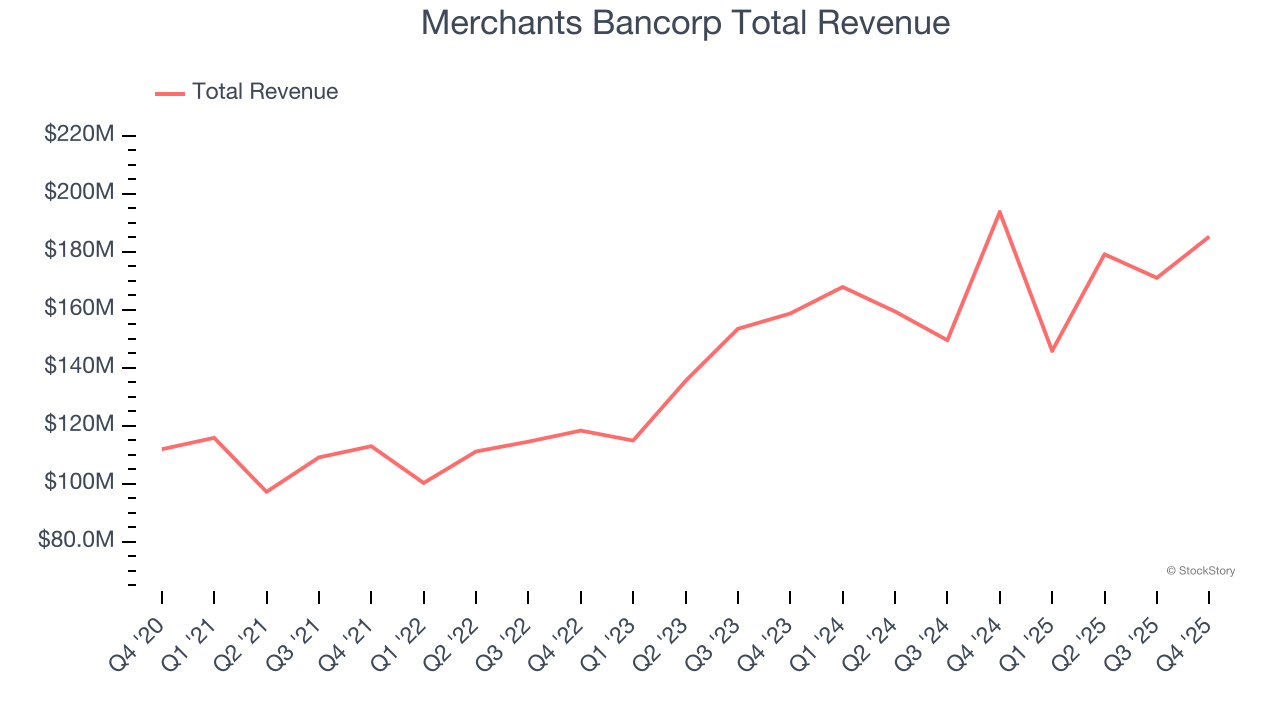
    Merchants Bancorp specializes in low-risk, government-backed lending, multi-family mortgage banking, mortgage warehousing, and traditional banking services. Q4 revenue was $185.3 million, down 4.4% YoY but exceeding analyst forecasts by 7.8%. EPS and net interest income also beat estimates. The stock has gained 21.9%, trading at $42.60.

    Merchants Bancorp Total Revenue Q4

    Underperformer: The Bancorp (NASDAQ: TBBK)

    The Bancorp provides banking services to fintech companies and specialty lending products. Q4 revenue was $172.7 million, up 8.2% YoY, missing analyst expectations by 11%. The stock has dropped 11%, now trading at $62.77.

    Ameris Bancorp (NYSE: ABCB)

    Ameris Bancorp serves retail and commercial clients across the southeastern U.S. Q4 revenue was $309.9 million, up 6.4% YoY, in line with forecasts. The company beat net interest income estimates and narrowly beat EPS. Stock is down 1.7%, trading at $79.89.

    OceanFirst Financial (NASDAQ: OCFC)

    OceanFirst Financial operates primarily in New Jersey. Q4 revenue was $97.08 million, up 1.6% YoY but 5.5% below analyst expectations. EPS beat estimates, but revenue missed. Stock is flat at $19.01.

    Investing in Regional Banks

    For investors seeking rock-solid fundamentals, regional banks like S&T Bancorp, Merchants Bancorp, and peers offer opportunities for growth, supported by stable earnings, loan growth, and expanding net interest margins.

    You may query:

    • regional banks
    • S&T Bancorp
    • NASDAQ STBA
    • Q4 earnings
    • regional bank earnings
    • Merchants Bancorp
    • NASDAQ MBIN
    • The Bancorp
    • NASDAQ TBBK
    • Ameris Bancorp
    • NYSE ABCB
    • OceanFirst Financial
    • NASDAQ OCFC
    • interest rates
    • net interest margins
    • digital transformation banking
    • loan demand
    • deposit outflows
    • fintech competition
    • credit deterioration
    • loan defaults
    • regulatory compliance costs
    • commercial real estate exposure
    • regional bank stability
    • financial institutions
    • banking stock analysis
    • EPS beat
    • revenue growth

  • UCB Q4 Results: How United Community Banks Stack Up Against Regional Rivals

    Q4 Regional Bank Earnings: Highlights and Insights

    As the earnings season concludes, we review standout—and some underperforming—results from Q4, focusing on regional banks. Today, we highlight United Community Banks (NYSE: UCB) and other key performers.

    Regional Banks: Opportunities and Challenges

    Regional banks are financial institutions operating within defined geographic boundaries, connecting local savers and borrowers. These banks often benefit from rising interest rates that widen net interest margins, digital transformation efforts reducing operational costs, and strong local economies that drive loan demand. However, challenges include fintech competition, deposit outflows, rising loan defaults during economic downturns, regulatory compliance costs, and stability concerns—particularly after high-profile failures and exposure to commercial real estate.

    Q4 Performance Overview

    Among the 95 regional banks we monitor, Q4 results were generally positive. Collectively, revenues beat analyst forecasts by 1.4%, with share prices rising an average of 2.5% since earnings announcements.

    United Community Banks (NYSE: UCB)

    Founded in 1950, United Community Banks has expanded through targeted acquisitions across the Southeast, providing lending, deposit accounts, wealth management, and merchant solutions.

    Q4 revenue reached $279.5 million, up 10.9% year-over-year, beating analyst expectations by 1.9%. EPS matched analyst projections, marking a mixed quarter. Chairman and CEO Lynn Harton stated: The fourth quarter capped off a strong year. Loan growth improved our mix of earning assets, and deposit pricing contributed to a 36 basis point increase in net interest margin year over year. We repurchased one million shares at $29.84 and redeemed $35 million in senior debt.

    Since reporting, the stock has risen 9.1%, trading at $35.45.

    Top Performer: Merchants Bancorp (NASDAQ: MBIN)

    Headquartered in Indiana, Merchants Bancorp focuses on low-risk, government-backed lending, specializing in multi-family mortgage banking and traditional banking services. Q4 revenue was $185.3 million, down 4.4% YoY but exceeding analyst expectations by 7.8%. Strong EPS and net interest income beats lifted the stock 21.9%, now trading at $42.60.

    Underperformer: The Bancorp (NASDAQ: TBBK)

    The Bancorp provides banking services to fintech companies and specialty lending products. Q4 revenue reached $172.7 million, up 8.2% YoY but missing analyst expectations by 11%. Significant shortfalls in tangible book value and revenue caused the stock to drop 11%, currently trading at $62.77.

    Washington Trust Bancorp (NASDAQ: WASH)

    Founded in 1800, Washington Trust Bancorp offers commercial banking, mortgage, personal banking, and wealth management services. Q4 revenue was $59.47 million, up 20.8% YoY and 4.2% above forecasts, with strong revenue and net interest income beats. The stock has surged 16.8%, trading at $35.27.

    Pathward Financial (NASDAQ: CASH)

    Formerly Meta Financial, Pathward Financial offers banking-as-a-service and commercial finance solutions. Q4 revenue totaled $173.1 million, flat YoY and 6.8% below forecasts, with missed net interest income estimates. Despite this, the stock has increased 14.1%, currently trading at $91.14.

    Discover High-Quality Investment Opportunities

    Investors seeking companies with strong fundamentals can explore regional banks with resilient earnings, sustainable loan growth, and net interest margin expansion to build portfolios positioned for long-term growth.

    You may query:

    • regional banks
    • United Community Banks
    • NYSE UCB
    • Q4 earnings
    • Merchants Bancorp
    • NASDAQ MBIN
    • The Bancorp
    • NASDAQ TBBK
    • Washington Trust Bancorp
    • NASDAQ WASH
    • Pathward Financial
    • NASDAQ CASH
    • interest rates
    • net interest margin
    • digital transformation banking
    • loan demand
    • deposit outflows
    • fintech competition
    • credit deterioration
    • loan defaults
    • regulatory compliance costs
    • commercial real estate exposure
    • regional bank stability
    • financial institutions
    • banking stock analysis
    • EPS beat
    • revenue growth

  • Westamerica Bancorporation (WABC) Q4 vs Regional Banks

    Q4 Earnings Review: Regional Banks Spotlight on Westamerica Bancorporation (WABC) and Key Players

    As the earnings season wraps up, we review notable Q4 results for regional banks, starting with Westamerica Bancorporation (NASDAQ: WABC).

    Overview of Regional Banks

    Regional banks are financial institutions that operate within specific geographic areas, connecting local depositors and borrowers. They benefit from rising interest rates, which improve net interest margins, digital transformation lowering operational costs, and strong local economic growth driving loan demand. Challenges include fintech competition, deposit outflows to higher-yield alternatives, credit deterioration during economic slowdowns, and regulatory compliance costs. Recent regional bank stability concerns following high-profile failures and significant commercial real estate exposure add additional headwinds.

    The 95 regional banks tracked reported satisfactory Q4 results, with revenues beating analysts’ consensus by 1.4%. Share prices are up 2.5% on average since earnings announcements.

    Westamerica Bancorporation (NASDAQ: WABC)

    Founded in 1884, Westamerica Bancorporation serves communities from Mendocino County to Kern County, providing banking services to individuals and small businesses across Northern and Central California.

    Westamerica reported Q4 revenues of $63.55 million, down 9.1% year-on-year, but exceeding analysts’ expectations by 2.7%. The company beat analysts’ net interest income estimates and revenue estimates.

    Westamerica’s fourth quarter 2025 results benefited from the company’s valuable low-cost deposit base, of which 46 percent were non-interest bearing checking accounts. The annualized cost of funding loan and bond portfolios was 0.24 percent, with operating expenses at 40% of total revenues. Nonperforming assets were stable at $1.8 million, and the allowance for credit losses was $11.6 million, said Chairman, President, and CEO David Payne.

    Westamerica Bancorporation Q4 Earnings

    Westamerica delivered the slowest revenue growth among the regional banks group. The stock is up 5.5% since reporting, currently trading at $51.18.

    Best Q4: Merchants Bancorp (NASDAQ: MBIN)

    Merchants Bancorp, based in Indiana, focuses on low-risk, government-backed lending programs, multi-family mortgage banking, and traditional banking services. Q4 revenues were $185.3 million, down 4.4% YoY, beating analysts’ expectations by 7.8%. EPS and net interest income exceeded estimates. The stock is up 21.9% since reporting, trading at $42.60.

    Merchants Bancorp Q4 Earnings

    Weakest Q4: The Bancorp (NASDAQ: TBBK)

    The Bancorp provides banking services to fintech companies and specialty lending. Q4 revenues were $172.7 million, up 8.2% YoY, but missing analysts’ expectations by 11%. The stock is down 11%, currently trading at $62.77.

    Other Regional Bank Highlights

    First Hawaiian Bank (NASDAQ: FHB) reported $225.9 million in revenue, up 5.4% YoY, in line with expectations. Stock is down 4.3%, trading at $26.38.

    Fifth Third Bancorp (NASDAQ: FITB) reported $2.35 billion in revenue, up 5% YoY, meeting expectations. The stock is up 5.7%, trading at $51.96.

    Investors looking for growth may explore market-beating stocks and regional banks with strong fundamentals for their portfolios.

    You may query:

    • regional banks
    • Westamerica Bancorporation
    • NASDAQ WABC
    • Q4 earnings
    • regional bank earnings
    • interest rates
    • net interest margins
    • digital transformation banking
    • loan demand
    • financial institutions
    • deposit outflows
    • fintech competition
    • credit deterioration
    • loan defaults
    • commercial real estate exposure
    • regulatory compliance costs
    • regional bank stability
    • Merchants Bancorp
    • NASDAQ MBIN
    • The Bancorp
    • NASDAQ TBBK
    • First Hawaiian Bank
    • NASDAQ FHB
    • Fifth Third Bancorp
    • NASDAQ FITB
    • market-beating stocks
    • banking stock analysis


  • Original Star Explains Why Prime Video’s Jack Ryan Spinoff Was Cancelled

    Michael Peña Explains Why Ding Chavez Jack Ryan Spinoff Never Happened

    The anticipated Ding Chavez Jack Ryan spinoff show never materialized, and actor Michael Peña recently shed light on the reasons behind its cancellation. Peña was introduced as Chavez in Tom Clancy’s Jack Ryan season 4 and was expected to star in a spinoff titled Rainbow Six.

    In an interview with ScreenRant, Peña suggested that rights issues could have prevented the Rainbow Six spinoff from happening. While he admits this is largely speculation, he also noted that the 2021 Without Remorse film moving from theatrical release to streaming may have been a contributing factor.

    “I think it was like, they couldn’t get the character,” Peña explained. When interviewer Liam Crowley clarified that he meant character rights, Peña elaborated on why the series was ultimately cancelled.

    The spinoff was intended to position Peña’s Chavez as a key ally to John Krasinski’s titular CIA character. The flagship Jack Ryan series appeared to set up the spinoff, but reports following season 4 suggested the project was never fully guaranteed.

    Instead of a fifth season of Jack Ryan, Krasinski’s character will appear in an upcoming feature film, which currently does not have a release date.

    Connection to Without Remorse and Rainbow Six

    Peña’s planned spinoff was part of a broader expansion of Amazon’s Clancy universe. Without Remorse (2021), which introduced Michael B. Jordan as Navy SEAL John Kelly, was intended for theaters but shifted to Prime Video due to the COVID-19 pandemic. The film performed well in viewership, despite mixed reviews, and a sequel—reportedly also titled Rainbow Six—is in development with Chad Stahelski attached as director.

    The Rainbow Six name comes from the elite counter-terrorism unit in Tom Clancy’s novels. Chavez was set to become a central leader of the team, but it’s unclear how the spinoff would have connected to the Without Remorse sequel, if at all.

    It’s possible Amazon chose not to pursue the Jack Ryan spinoff to avoid confusion between a series and a movie exploring the same unit. As of now, there have been no updates on Stahelski’s project, leaving the spinoff in limbo.

    For now, Peña’s remarks make it clear that audiences shouldn’t expect a Ding Chavez Jack Ryan spinoff anytime soon.

  • Partial Results Put Costa Rican President’s Chosen Successor on the Verge of Victory

    Laura Fernández Poised to Win Costa Rica Presidential Election

    CARTAGO, Costa Rica (AP) — Preliminary results indicate that Costa Rica’s president’s handpicked successor is set to win the presidency in a crowded field following Sunday’s election.

    The Supreme Electoral Tribunal reported that with votes from 88.4% of polling stations counted, conservative populist Laura Fernández of the Sovereign People’s Party had 48.5% of the vote. Her closest rival, economist Álvaro Ramos of the National Liberation Party, held 33.3%.

    Ramos conceded Sunday night, pledging to lead a “constructive opposition” while holding those in power accountable. In democracy dissent is allowed, criticizing is allowed, he said.

    After Ramos’ concession, Fernández addressed her supporters, and President Rodrigo Chaves congratulated her. Costa Rica has voted and it has voted to continue the change, a change that only seeks to rescue and perfect our democratic institutions and return them to you, to the sovereign people, to create more well-being and prosperity for our people, Fernández said.

    At least 40% of the vote is required to win in the first round; otherwise, the top two candidates will advance to a runoff on April 5. Fernández campaigned on continuing the policies of the term-limited Chaves.

    Security Concerns and Voter Motivation

    The historically peaceful Central American nation has seen a surge in crime in recent years, which could have influenced voter decisions. Some blame Chaves’ presidency for failing to reduce violence, while others support his confrontational style as the best approach to curb crime.

    Fernández previously served as Chaves’ minister of national planning and economic policy and later as minister of the presidency. She was considered the frontrunner heading into Sunday’s election and is Chaves’ favored successor.

    National Assembly Elections

    Costa Ricans also voted for the 57-seat National Assembly. Chaves’ party is expected to gain seats, though it may not achieve the supermajority required to, for example, appoint Supreme Court magistrates.

    Of the twenty contenders for president, only Fernández and Ramos received more than 5% of the vote in preliminary results.

    Voter Turnout

    Some 3.7 million Costa Ricans were eligible to vote, with polls open from 6 a.m. to 6 p.m. on Sunday. Early voter Ronald Loaiza cast his ballot in Cartago, about 25 kilometers east of San Jose. I hope that it’s a democratic celebration, that the people come out to vote. It’s very important that we exercise the right that this country gives us, that we’re conscious of our democracy, he said.

    Chaves’ Outsider Campaign

    Four years ago, Rodrigo Chaves ran as an outsider, defeating traditional parties despite briefly serving as economy minister in a previous administration. His framing of traditional parties as corrupt and self-interested resonated in a country struggling with high unemployment and a soaring budget deficit.

  • Rising Crime, Inequality, and Discontent: What’s at Stake in Costa Rica’s Elections

    Costa Rica Presidential Election: Polls Close Amid Crime Concerns

    Polls have closed in Costa Rica after voters headed to the ballot box Sunday to choose a new president, following an election season overshadowed by crime and political apathy.

    Amid persistent violence from criminal groups in a country long considered a peaceful tourist hub, polling shows that Costa Ricans are most concerned about security this year. Voters are also distressed by the decline in their quality of life and the country’s complex political landscape, reflected by the twenty candidates running for president.

    Preliminary results indicate an early lead for right-winger Laura Fernández, of the country’s ruling party, who has secured 53.01% of the votes with roughly a third of the polling stations counted.

    Her closest rival, Álvaro Ramos Chaves, a centrist economist representing Costa Rica’s oldest political party, currently holds second place with 30.05% of the vote, according to the Supreme Electoral Tribunal.

    In Costa Rica, a candidate must obtain at least 40% of the vote to win the presidency in the first round. If no one reaches that threshold, the top two candidates proceed to a runoff.

    Fernández’s lead heading into election day puts her close to winning in the first round, according to the Center for Research and Political Studies of the University of Costa Rica (CIEP-UCR). Interestingly, more than a quarter of CIEP-UCR survey respondents were undecided before polling day.

    Security Challenges in a Country Without an Army

    Costa Rica’s struggle with criminal violence is a striking irony. The country has long been a model of peace and was the first nation to abolish its armed forces, a source of national pride in a region often marked by political turmoil.

    Government data shows that the last three years have been among the most violent in Costa Rican history, with 905 homicides recorded in 2023—a historic high. Officials attribute much of the violence to drug trafficking. In January, the US Treasury claimed the country had become a “key global cocaine transshipment point.”

    Costa Rica is not alone: crime-related concerns have recently influenced elections across Latin America, from Ecuador to Chile to Honduras. The region’s struggle against crime is exemplified by El Salvador and its leader Nayib Bukele, who reduced murder rates through mass imprisonment and strict policing but faces human rights allegations related to his Terrorism Confinement Center (CECOT).

    Bukele has sought to promote his security approach in Costa Rica, where the government broke ground on a CECOT-style prison last month with his endorsement. Retiring President Rodrigo Chaves stated at the ceremony, “Nayib Bukele’s presence is important, legitimate, and honors us.”

    Economic Growth – But Unequal

    According to a 2025 report from the State of the Nation Program (PEN), Costa Rica experienced an economic rebound in 2024 and the first half of 2025. The country became the first in Central America to join the Organization for Economic Cooperation and Development (OECD) in 2021, whose latest reports indicate an improved fiscal situation, declining unemployment and debt, and a growing share of tech products in exports.

    Among peer nations, the OECD reported that Costa Rica’s growth has been “more resilient and stronger.” However, PEN political scientist Leonardo Merino notes that these upward-trending numbers show only half of the story.

  • Caitlin Foord Secures Arsenal Champions Cup Win in Extra Time

    Arsenal Win Inaugural Women’s Champions Cup After Extra-Time Thriller

    Arsenal were crowned the inaugural Women’s Champions Cup winners after substitute Caitlin Foord scored the decisive goal to inspire the Gunners to a 3-2 extra-time victory over Brazilian side Corinthians.

    The FIFA club competition final was played under heavy rain at the Emirates Stadium, with Arsenal also securing $2.3 million (£1.67m) in prize money.

    Corinthians captain Gabi Zanotti equalised Olivia Smith’s 15th-minute opener before Lotte Wubben-Moy nodded Arsenal back in front after the break.

    Arsenal seemed poised to win, but a stoppage-time penalty scored by Vic Albuquerque forced extra time. Under the downpour, Arsenal battled back, with Foord scoring the winner in the first period of extra-time.

    Celebrations were briefly subdued after Arsenal goalkeeper Anneke Borbe was injured in a late collision and removed from the pitch on a stretcher following treatment.

    Corinthians goalkeeper Letícia saved a sharp effort from Stina Blackstenius, but could not stop Smith’s opener after the rebound fell to the Canada international, who scored confidently.

    Zanotti equalised in the 21st minute, heading home from a corner off Kim Little to create a goalmouth scramble before referee Katia Garcia confirmed the goal.

    Arsenal regained the lead in the 58th minute when Wubben-Moy rose to meet Emily Fox‘s cross, sending the ball past Letícia.

    Just as the victory seemed certain, Katie McCabe conceded a penalty, confirmed by VAR, after a challenge on Gisela Robledo. Albuquerque calmly scored down the middle, sending the match into extra time.

    Both sides had early chances in extra time, but Arsenal’s counter-attack, initiated by Maanum and finished by Foord, sealed the 3-2 win.

    Gotham FC Claim Third Place

    Gotham FC defeated ASFAR 4-0 in the third-place match earlier in the day. Khyah Harper, who came on as a substitute in the semifinal, opened the scoring in the 27th minute.

    Savannah McCaskill doubled the lead, Jaedyn Shaw converted a penalty to make it 3-0 before halftime, and Midge Purce added the final goal in the 48th minute.

    Information from PA and The Associated Press was used in this recap.

  • Futures Fall on Silver, Bitcoin Weakness; AI Trade Uncertainty Builds

    Stock Futures Slip as Wall Street Watches Bitcoin Sell-Off

    Stock futures fell on Sunday night as Wall Street kicked off a new month of trading, with investors closely monitoring bitcoin following a sharp weekend sell-off.

    Dow Jones Industrial Average futures fell 143 points, or 0.3%. S&P 500 futures declined 0.6%, while Nasdaq-100 futures dropped nearly 1%.

    Bitcoin slipped below $80,000 for the first time since April, signaling that investors were pulling back on risk after Friday’s steep declines in precious metals. Silver, which has more than doubled over the past 12 months, plunged roughly 30% on Friday, marking its worst single-day performance since 1980. Gold also fell around 9%.

    Bitcoin was last trading near $76,000.

    Wall Street also shifted its focus to Nvidia as uncertainty surrounding the artificial intelligence sector emerged.

    The Wall Street Journal, citing sources familiar with the matter, reported that Nvidia’s proposed $100 billion investment in OpenAI has stalled, with company executives expressing concerns about moving forward with the deal.

    Big Earnings and Jobs Data Ahead

    More than 100 S&P 500 companies are scheduled to report earnings this week, including Amazon, Alphabet, and Disney. While the current earnings season has largely been strong, several high-profile stocks have faced sharp post-earnings sell-offs, including Microsoft.

    Despite this volatility, Deutsche Bank strategists said over the weekend that corporate earnings growth is on pace to be the strongest in four years.

    Investors are also awaiting the release of the January U.S. jobs report, scheduled for Friday morning. Economists surveyed by Dow Jones expect that around 55,000 jobs were added last month.

    Stocks are coming off a losing session after major market indexes declined Friday, following President Donald Trump announcing Kevin Warsh as his nominee for Federal Reserve chairman. If confirmed, Warsh would replace Jerome Powell later this year.

  • Erling Haaland’s Agent Demands Transfer Change Ahead of Deadline


    Football Super-Agent Rafaela Pimenta Calls for Transfer System Change

    Football super-agent Rafaela Pimenta has called for significant changes to the football transfer system on the eve of transfer deadline day. The qualified lawyer, whose highest-profile client is Erling Haaland, believes that football clubs currently hold too much power in transfers.

    Pimenta, 53, who previously worked closely with the late Mino Raiola, has inherited his clients since the super-agent’s death nearly four years ago. She also manages Liverpool head coach Arne Slot, as well as Manchester United stars Matthijs de Ligt and Noussair Mazraoui.

    Pimenta Speaks Out on the Transfer System

    Speaking to the BBC, Pimenta stated: There needs to be a change; there’s too much power for clubs, players are sometimes hostages of situations. I’m not fighting for chaos; we need the transfer system to make the whole thing work, but we need more balance.

    She continued: We are in a transfer window, and I can bet you, because I see it at the end of every window, somebody will cry. There’s always a player crying because he could have gone, needed to go, and a club said they want £1m more.

    Football used to be more human; a football director or an owner would have a special relationship with the player. If a player went to them and said, ‘Please, I need to go,’ they would find a solution.

    Today, football is becoming so much of a business that there is a risk that players become an asset on the balance sheet; an asset has no voice, no feelings, no human needs. The challenge is to find a balance between the asset and the human being.